
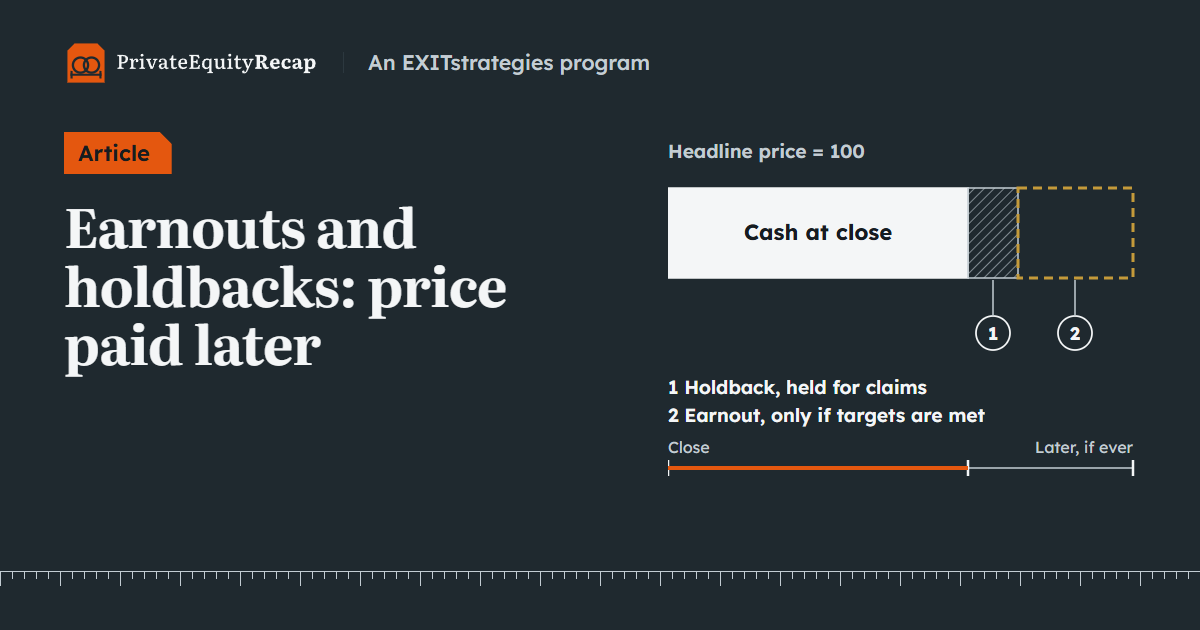
The headline price in a letter of intent is rarely the amount wired to you at closing. Part of it may be held back to cover claims, part may depend on how the business performs after you sell, and the final number can move with a working capital adjustment. None of this is unusual. All of it is negotiable, and most of it is settled before the purchase agreement is final.
Three ways part of the price is paid later
An earnout is "contingent additional purchase price based on the company's post-closing performance" (Schwabe (opens a new tab)). It is paid only if the business hits agreed targets.
A holdback, or escrow, keeps part of the price back at closing, often with a third-party escrow agent, to pay any claims the buyer makes under the promises you give in the purchase agreement.
A working capital adjustment moves the price up or down depending on whether the business delivers the agreed level of working capital: current assets minus current liabilities. In a 2014 survey cited by Schwabe, 86% of deals included a post-closing adjustment provision (Schwabe (opens a new tab)). Dated; typical, varies The target is often based on a trailing twelve-month average, which may not fit if the business changed during that period.
Earnouts: price that depends on what happens next
Most earnouts run between two and five years after closing. They are measured against financial figures, most commonly revenue or EBITDA, or against milestones such as winning a large customer (Schwabe (opens a new tab)). Typical, varies
An earnout bridges a gap: you believe next year will be strong, and the buyer wants proof before paying for it. The cost of bridging it is that you no longer control the business that has to hit the number. Schwabe notes that earnouts "present significant risk of manipulation and post-closing dispute." Sellers worry that a buyer will change the accounting or run the business in a way that holds results down; buyers worry about paying for growth they created themselves.
What to pin down in writing
- The exact metric and how it is calculated, ideally with a worked example in the agreement.
- The accounting rules: the same methods the business used before closing.
- What the buyer must and must not do during the earnout: budgets, staffing, pricing, and moving customers or work to other companies it owns.
- What happens if the company is sold, merged or restructured before the earnout ends.
- Whether hitting part of a target pays part of the earnout, or nothing.
- What reports you will see, how often, and how a disagreement is resolved.
Hypothetical illustration. Headline price = 100: cash at close 70, holdback 10, earnout up to 20. Not a client result, a prediction or typical terms, and the cases are not equally likely. Fees, taxes, debt and any rolled equity are ignored.
| Case | Earnout paid | Holdback returned | Total received |
|---|---|---|---|
| Target met in full | 20 | 10 | 100 |
| Half the target | 10 | 10 | 90 |
| Target missed | 0 | 10 | 80 |
| Missed, plus a claim of 5 | 0 | 5 | 75 |
In this example, 30 of the 100 was never certain at closing. That is the number to look at before you compare offers: how much is cash at close, and how much depends on events after you hand over control.
Holdbacks and escrow: price held against your promises
In the purchase agreement you make promises about the business, for example that the financial statements are accurate and that there are no undisclosed lawsuits. If one turns out to be wrong, the buyer can claim against you. A holdback keeps part of the price in escrow to pay those claims.
How big? In a 2014 survey cited by Schwabe, the average escrow was 9.14% of the purchase price and the median was 7.5% (Schwabe (opens a new tab)). Dated; typical, varies Treat that as a reference point, not a norm.
How long? The holdback usually tracks how long your promises survive. General promises often survive about 12 months to 2 years; some, such as tax, environmental and employment matters, can survive until the legal deadline for claims runs out (Schwabe (opens a new tab)). Typical, varies
What to negotiate
- The size of the holdback, and whether it is released in stages.
- A claims process with written notice and evidence, and a deadline.
- A cap on what the buyer can claim, and a minimum size below which small claims are not made.
If you are rolling equity too
In a majority recap, the earnout, the holdback and your rolled stake all depend on the same new owner running the business. That concentrates your risk: one weak stretch can cut the earnout and the value of your stake at the same time. Our article on the second sale explains what happens to the rolled stake.
Caution
Retained ownership and future upside are possibilities, not promised second paydays. Rolled or retained equity is usually illiquid, often a minority position behind acquisition debt, and can lose some or all of its value.
Taxes: your CPA decides
When and how earnout and holdback payments are taxed depends on deal structure and your situation. IRS Publication 537 covers installment sales, where at least one payment arrives after the tax year of the sale, including "contingent payment" sales in which the total price cannot be determined by the end of that year (IRS Publication 537 (opens a new tab)). Whether those rules apply to you, and how, is for your CPA or tax attorney to decide.
Questions to ask any buyer
- How much of the price is cash at close?
- What exactly does the earnout measure, over what period, and who controls the inputs?
- Does the earnout speed up, or pay out, if you sell the company?
- How large is the holdback, how long is it held, and when is each part released?
- How is the working capital target set?
- What is the cap on claims against me?
Sources for this article
If an offer you have received includes an earnout or a holdback, ask us how it compares. We work on control transactions: a full sale, or a majority recap in which a buyer acquires a controlling interest and takes an active role in running the business. We introduce qualified buyers, including private equity groups, family offices and strategic acquirers. We do not arrange minority investments or growth-capital raises; if one may fit, we can refer you to a registered broker-dealer.