
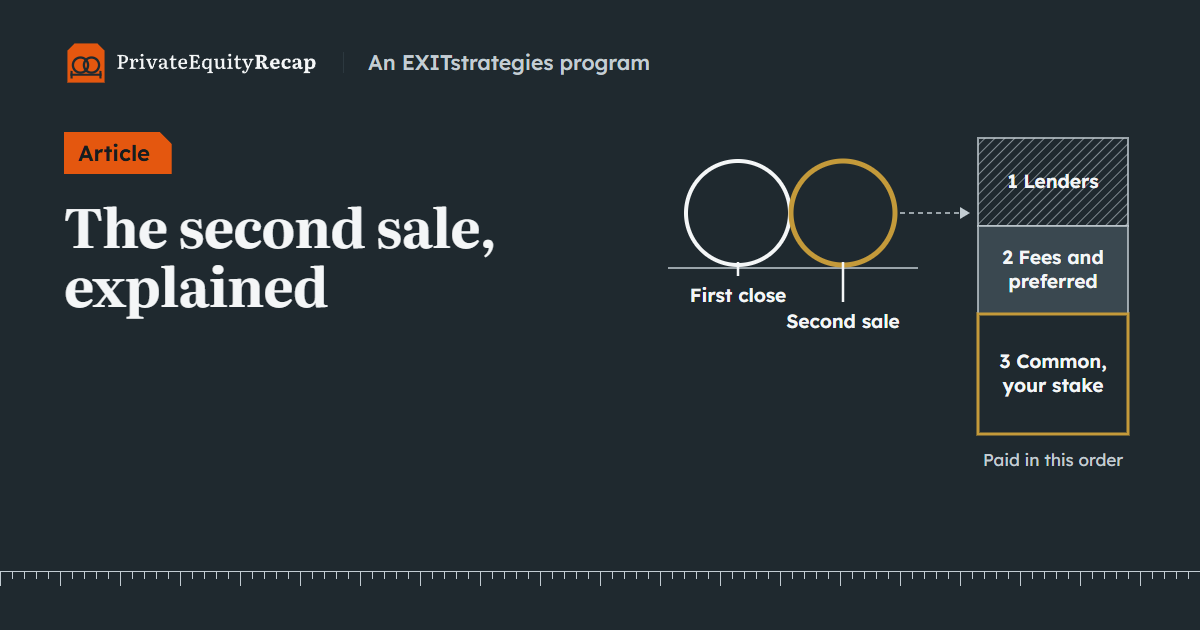
In a majority recap you sell control now and keep a stake. Most owners focus on the first close, because that is when the cash arrives. The stake you keep pays out at a different moment: the second sale, when the private equity owner sells the company again. This article walks through how that second sale works, who gets paid before you, and what to settle in writing before you roll anything.
Why a second sale is part of the plan
A private equity fund buys companies in order to sell them later. When it sells, the stake you rolled is usually sold along with everyone else's. People call this the "second bite of the apple." Treat that phrase as a defined term, not a promise: it means a possible second sale of your retained stake, often years later, and it can be worth more, less or nothing.
How long until then? Advisors often say three to six years (OffDeal (opens a new tab)). A study of 13,757 private equity exits from 2021 to mid-2026 put the typical hold at 6.0 years, and holds have been getting longer (Private Equity Info (opens a new tab)). Typical, varies Nobody can promise you a date, and in most deals you do not choose it.
What you own between the two sales
A rolled stake often falls somewhere in the 10% to 30% range, and can be higher for founders who stay (Porte Brown (opens a new tab)). Typical, varies How that percentage is measured varies: a share of your sale proceeds, or a share of the new company. Ask which one a buyer means, because the two can be far apart.
Either way, the stake is a security issued by the buyer's company, with its own risks. Under the federal rule for M&A brokers, when a seller is offered securities such as rollover equity, the seller should receive, before becoming bound, the issuer's financial statements for its last fiscal year, a balance sheet no more than 120 days old, and information about its management, its operations and any material loss contingencies (15 U.S.C. 78o(b)(13) (opens a new tab)). Read them the way a buyer reads yours.
Between the two sales your stake is illiquid: you usually cannot sell it on your own. It is usually a minority position, and the company often carries acquisition debt, the loan the buyer took on to help pay for your first close.
Who gets paid first when the company sells again
The second sale price is not split by ownership percentage from the top down. Money flows down a ladder, often called the waterfall:
- Lenders. The debt on the company is repaid first.
- Fees, then preferred equity. Preferred equity means shares that are paid back before ordinary shares.
- Common equity, including your stake. Paid from whatever is left.
That ladder is why a headline sale price can mislead. Here is the same stake at four second-sale prices, first with nothing ahead of you, then with debt and preferred equity ahead of you.
Hypothetical illustration. Round index numbers: the company's value at your first close = 100, and you own 20% of the common equity. In the right-hand column, 40 of debt and 30 of preferred equity sit ahead of the common shares. Not a client result, a prediction or a valuation, and not typical terms. The cases are not equally likely. Fees, taxes, interest and dilution are ignored.
| Case | Company sells for | Your stake, nothing ahead of you | Your stake, 70 ahead of you |
|---|---|---|---|
| Better | 150 | 30 | 16 |
| Flat | 100 | 20 | 6 |
| Lower | 60 | 12 | 0 |
| Fails | 0 | 0 | 0 |
Read the right-hand column twice. In the flat case the company sells for exactly what it was worth at your first close, yet your stake returns less than a third of what it would with nothing ahead of it. In the lower case it returns nothing at all. The debt and the preferred terms in your deal can matter as much as the sale price.
Caution
Retained ownership and future upside are possibilities, not promised second paydays. Rolled or retained equity is usually illiquid, often a minority position behind acquisition debt, and can lose some or all of its value.
The clauses that decide when, and on what terms, you sell
Drag-along. Lets the controlling owner require you to sell on the same terms when it sells. In practice this is why you usually cannot say no to the second sale, or pick the next buyer.
Tag-along. Lets you join a sale on the same terms, so the controlling owner cannot sell its shares and leave you behind with a new owner.
Repurchase if you leave. "Most rollover equity is subject to repurchase rights upon termination of employment" (FBT Gibbons (opens a new tab)). If you leave, or are let go, before the second sale, the company can often buy your stake back on a formula. Typical, varies Find out what the formula is, and whether the price depends on why you left.
A seat at the table. Rollover owners may get a board seat or observer rights, depending on the size of their stake (FBT Gibbons (opens a new tab)). Typical, varies An observer attends meetings but does not vote.
Information. Ask how often you will see financial statements. Without them you cannot tell how the debt, the preferred return and the value of your stake are moving.
Taxes at the second sale: your CPA decides
Tax treatment depends on deal structure and your situation. Some structures may defer tax on the rolled portion at the first close; whether yours does depends on how the deal is built, under rules such as sections 721 (opens a new tab), 351 (opens a new tab) and 368 (opens a new tab) of the Internal Revenue Code. Cash or other property you receive alongside rolled shares is generally taxable. A deferral usually means tax later, not no tax: the deferred gain generally comes back into play when the stake is sold. Your CPA or tax attorney decides. Bring them in before the letter of intent, while the structure is still open.
Questions to ask before you roll
- Is my rolled equity the same class as yours, or is your equity paid first?
- Show me the waterfall at a good, a flat and a bad second sale.
- How much debt will the company carry, and can you add more later?
- What fees come out before the common shares are paid?
- What are my rights if you sell, refinance or raise new capital?
- Is there a drag-along, a tag-along, or both, and on what terms?
- If I leave, what is the repurchase formula?
- Which financial statements will I receive, and how often?
Adapted, in our own words, from a seller's checklist in LeverUp, "The second bite" (opens a new tab).
Part of the first-close price can also be paid later. Our article on earnouts and holdbacks covers how that works.
Sources for this article
- OffDeal, selling an HVAC business to private equity (opens a new tab)
- Private Equity Info, holding periods (opens a new tab)
- Porte Brown, rollover equity (opens a new tab)
- 15 U.S.C. 78o(b)(13), the federal M&A broker rule (opens a new tab)
- FBT Gibbons, minority issues for rollover participants (opens a new tab)
- 26 U.S.C. 721 (opens a new tab)
- 26 U.S.C. 351 (opens a new tab)
- 26 U.S.C. 368 (opens a new tab)
- LeverUp, "The second bite", commentary (opens a new tab)
If a buyer has made you an offer, or you want to see how these terms would apply to your company, ask us. We work on control transactions: a full sale, or a majority recap in which a buyer acquires a controlling interest and takes an active role in running the business. We introduce qualified buyers, including private equity groups, family offices and strategic acquirers. We do not arrange minority investments or growth-capital raises; if one may fit, we can refer you to a registered broker-dealer.